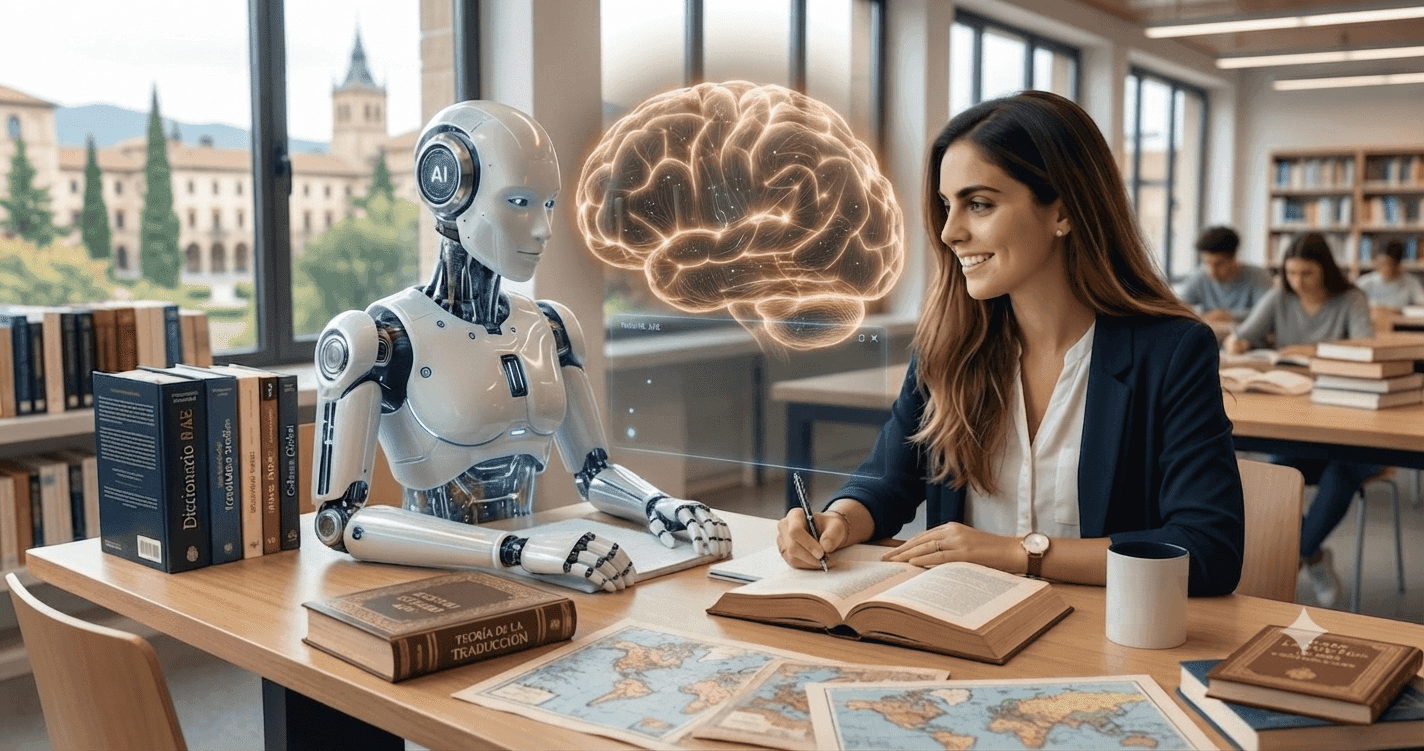
How Artificial Intelligence Is Changing the Translation Workflow
We explore how AI is transforming the translation industry, balancing technological productivity with the precision of professional human review.
The landscape of professional translation has undergone a seismic shift. For years, the industry relied on traditional methods, but the arrival of sophisticated language models and neural engines has fundamentally altered the translation workflow. For businesses, this change can feel overwhelming. Is it time to rely entirely on automation, or is the human element more critical than ever?
As a professional translator, I have witnessed these tools evolve from simple word-swapping engines into powerful partners. Today, the conversation is not about AI versus human translation; it is about how we integrate technology to produce better, faster, and more consistent results for companies operating in a global market.
In short: today's professional translation workflow combines AI-powered machine translation for speed with human post-editing for accuracy, cultural nuance, and brand voice — not one replacing the other. A modern translation workflow typically looks like: source file → CAT tool with a neural MT engine → translation memory and glossary matching → human review and refinement → final QA. Businesses that skip the human step risk literal translations, invented terminology, or tone that doesn't fit the target market — the trade-offs are covered in detail below.
What has changed in the translation industry?
Not long ago, translation was a linear, manual process. You received a document, translated it sentence by sentence, and proofread the result. While precision was high, the time required to complete large-scale projects was significant.
Today, the workflow is iterative and multi-layered. Modern translation is no longer just about knowing two languages; it is about managing a complex ecosystem of data, terminology, and software. The industry has moved away from "just translating" toward "translation engineering." This shift is largely driven by the ability to handle vast amounts of data simultaneously, ensuring that a brand’s voice remains consistent across thousands of pages of technical, marketing, or legal content.
What role does Artificial Intelligence play today?
Artificial Intelligence in translation is not a monolithic concept. It manifests in several ways, ranging from basic pattern recognition to advanced Large Language Models (LLMs) like those powering ChatGPT or specialized neural engines.
In a professional setting, AI acts as an accelerator. It suggests translations for repeated segments, predicts terminology based on context, and handles repetitive tasks that would otherwise drain a translator’s cognitive resources. It allows us to focus our attention where it matters most: the nuance, the cultural adaptation, and the strategic intent behind the message.
AI is a tool, not a replacement
There is a misconception that AI will render translators obsolete. In my professional experience, the opposite is true. The more AI-driven automation we implement, the more demand there is for highly skilled human linguists.
AI is excellent at processing massive volumes of content, but it lacks the capacity to understand high-level business strategy, emotional subtext, or the specific regulatory environment of a niche market. It does not possess ethical judgment. A professional translator acts as the final gatekeeper, ensuring that the AI’s output—which can sometimes be logically sound but culturally inappropriate—is refined into a piece of communication that achieves your business goals.
How professional translators actually use AI
Translators are now "post-editors" and "language engineers." When I start a project today, my workflow often looks like this:
- Preparation: I feed the source files into a CAT tool, which uses a pre-trained neural engine to generate a high-quality initial draft.
- Data leverage: The tool automatically suggests translations based on previous projects, ensuring consistent terminology.
- Human refinement: I step in to perform MTPE Services. This is where I ensure the tone is correct, correct any "hallucinations" (where the AI invents information), and adapt cultural markers.
- Final Polish: I perform a Proofreading Services pass to ensure the text reads as if it were written by a native speaker.
This approach saves time without compromising the authority of the original content.
The technologies behind modern translation
Modern translation relies on a stack of integrated technologies that work in harmony:
Neural Machine Translation (NMT)
This is the "engine" that provides the initial draft. Unlike older statistical models, NMT understands whole sentences and context, leading to remarkably fluent results.
CAT Tools
Computer-Assisted Translation tools are the central hub for every professional. They split texts into manageable segments and organize everything into a database for future reference.
Translation Memories (TM)
These are databases that store every sentence I have ever translated for a specific client. If a company updates a technical manual, the TM ensures we only translate the new or changed parts, saving the client money and ensuring consistency across versions.
Terminology Management
This technology allows us to lock in specific product names, legal terms, or industry-specific jargon. It prevents the engine from choosing a generic synonym when your company requires a specific technical term.
Quality Assurance (QA)
Automated QA checks for missing numbers, inconsistent punctuation, or untranslated segments. It is a vital safety net that identifies human errors that might slip through even the most careful read-through.
Benefits of AI for companies
When integrated professionally, AI offers clear advantages for businesses:
- Scalability: You can translate large amounts of documentation that would be impossible to cover manually in the same timeframe.
- Cost efficiency: By leveraging previous work (through translation memories) and using AI to speed up the drafting process, costs for long-term projects are significantly reduced.
- Speed to market: You can launch your product manuals, software interfaces, or web content in multiple languages simultaneously, gaining a competitive edge in new markets.
Limitations and risks of AI-generated translations
While AI is impressive, it is not infallible. Relying on "raw" machine translation (without human intervention) poses risks:
- Lack of context: AI may choose a word that is technically correct in a dictionary but wrong for your specific industry (e.g., translating "drive" as "conducir" for a mechanical valve instead of "accionar").
- Hallucinations: AI can sometimes generate information that is not in the source text, which can be legally or technically dangerous.
- Cultural blindness: AI does not understand local taboos or the way different cultures perceive brand identity, potentially leading to offensive or awkward marketing materials.
Which types of content benefit most from AI?
AI is most effective for content that follows a logical structure and relies on specific, consistent terminology:
- Technical manuals and engineering specifications.
- Large-scale software documentation.
- Internal corporate communications.
- E-commerce product descriptions with recurring features.
For these documents, the combination of a robust neural engine and human post-editing is the most efficient path forward.
Which types of content should always be translated by humans?
Content that requires a high degree of empathy, creativity, or legal nuance should remain in human hands:
- Marketing campaigns and brand storytelling.
- Legal contracts and binding corporate agreements.
- Public-facing communications during a crisis.
- Creative content that relies on metaphors, irony, or specific cultural humor.
For these projects, human intuition and Translation Services are indispensable.
The future of AI and professional translation
The future of translation is hybrid. We are moving toward a model where AI takes care of the "heavy lifting"—the repetitive, time-consuming tasks—while the professional translator moves into a role of a strategist, editor, and quality manager.
The standard for the industry is now defined by ISO 18587, the international standard for post-editing. As a professional, I align my workflow with these quality standards to ensure that no matter what technology we use, the final result is always professional, accurate, and ready for your audience.
Conclusion
Artificial intelligence has made the translation industry more efficient, more scalable, and more capable than ever before. However, the core of successful communication remains unchanged: it is about connecting with people. Technology provides the bridge, but human expertise ensures that the bridge is built on solid, reliable, and culturally appropriate foundations.
If you are looking to integrate these technologies into your business, it is essential to work with professionals who understand how to balance efficiency with quality.
Are you unsure which workflow is best for your specific project? I invite you to Contact me to discuss your documentation needs and find the strategy that best fits your goals.
FAQ
1. Can AI replace professional translators?
No. AI excels at processing information, but it lacks the nuance, cultural awareness, and responsibility of a professional translator. It is a powerful tool, not a replacement.
2. Is raw machine translation safe for my business?
Generally, no. Without human review, you risk errors in terminology, logical inconsistencies, and cultural blunders that could damage your brand's reputation.
3. What is MTPE?
MTPE stands for Machine Translation Post-Editing. It is a professional workflow where a machine generates a draft, and a human expert reviews and refines it to ensure it meets professional standards.
4. How do I know if my project is suitable for AI-assisted translation?
Projects with repetitive content, technical manuals, or large volumes of documentation are perfect for AI. Creative or high-stakes legal texts usually require traditional human translation.
5. Is my data secure when using AI tools?
It depends on the tools. Professional translators use secure, encrypted environments to ensure that your business documents and confidential data are never exposed or used to train public AI models.
6. Will I save money by using AI?
Yes. By using AI as part of a professional workflow, we can leverage your previous translations and speed up the process, which usually leads to lower overall costs for high-volume projects.
7. Do I need to be tech-savvy to work with a translator who uses AI?
Not at all. My job is to manage the technology and ensure that you receive a high-quality, ready-to-use translation. You provide the source files; I handle the technical workflow.
8. What is the difference between Google Translate and professional AI tools?
Professional tools allow for the integration of your company's specific glossaries, memories, and style guides. They are also designed with data privacy as a priority, unlike free web-based tools.
Boost Your Brand with My Expertise
Discover the range of services I offer to help your brand grow, connect with your audience, and achieve your business goals. Each solution is tailored to your needs.
Looking for a freelance translator? Let's Discuss